If you've started shopping for a hunting scope, you've probably noticed there are hundreds of options. Every manufacturer claims to have brighter glass, better coatings, more advanced reticles, and the latest technology.
After helping hunters choose rifle scopes for more than two decades, we've learned something surprising.
By the time you finish this guide, you'll know how to choose a hunting scope that fits your rifle, your hunting style, and your budget—without paying for features you don't need.
That's exactly what we're going to do in this guide.
The First Questions We Ask Every Customer
When someone contacts us looking for a hunting scope, we usually start with two questions:
- What's your budget?
- What are you hunting, and where do you hunt?
Budget helps narrow the options, but how and where you hunt ultimately determines which scope is the best fit.
One thing we've learned over the years is that two hunters with the same budget often leave with completely different scopes. Why? Because they hunt in different environments, pursue different game, and shoot at different distances. The best scope isn't determined by price alone—it's determined by how you'll use it.
A hunter sitting in a hardwood tree stand in Pennsylvania has very different needs than someone chasing mule deer across Wyoming or calling coyotes across open farm country.
The Biggest Mistake Hunters Make
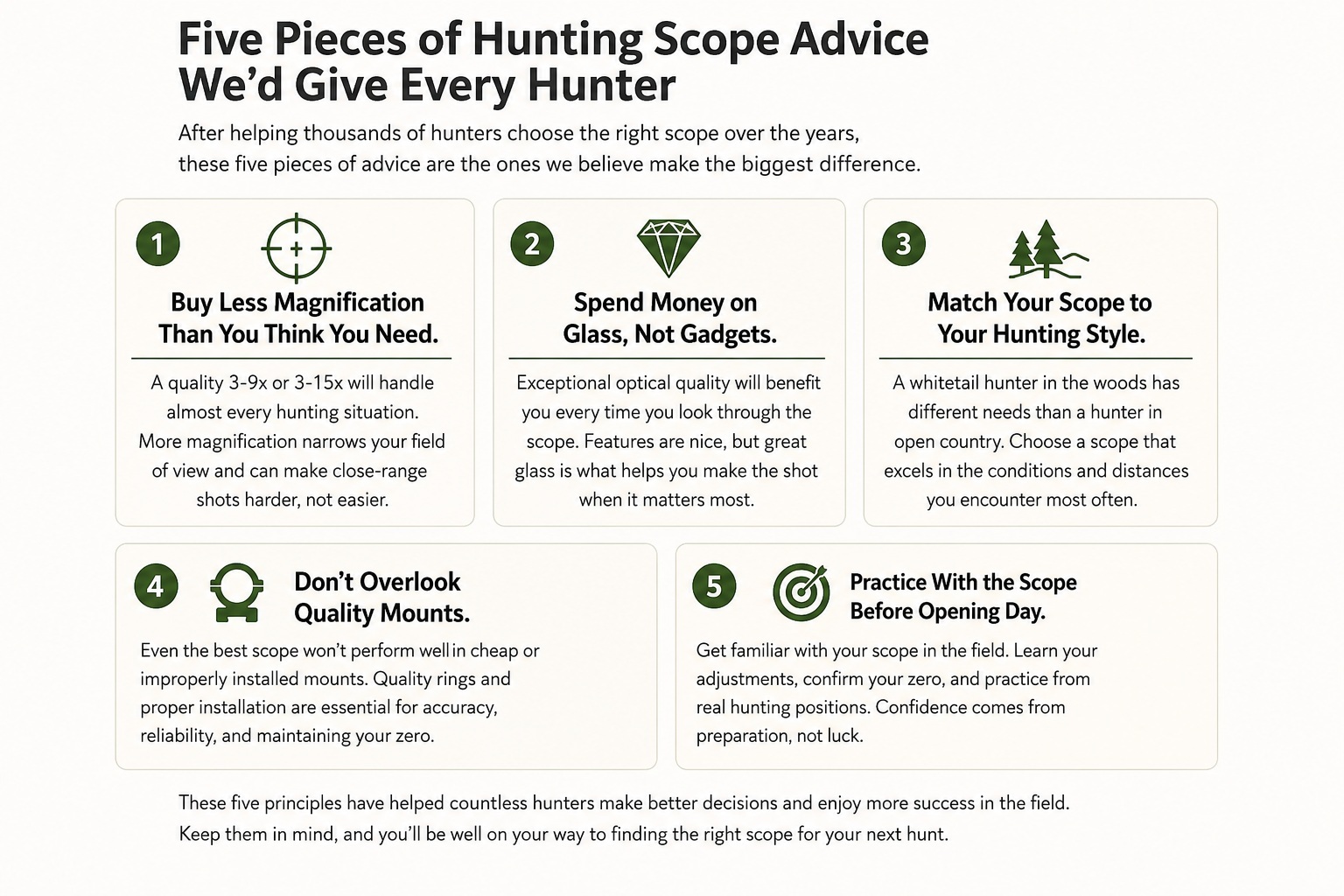
If we had to name the single most common mistake hunters make when choosing a scope, it would be buying too much magnification.
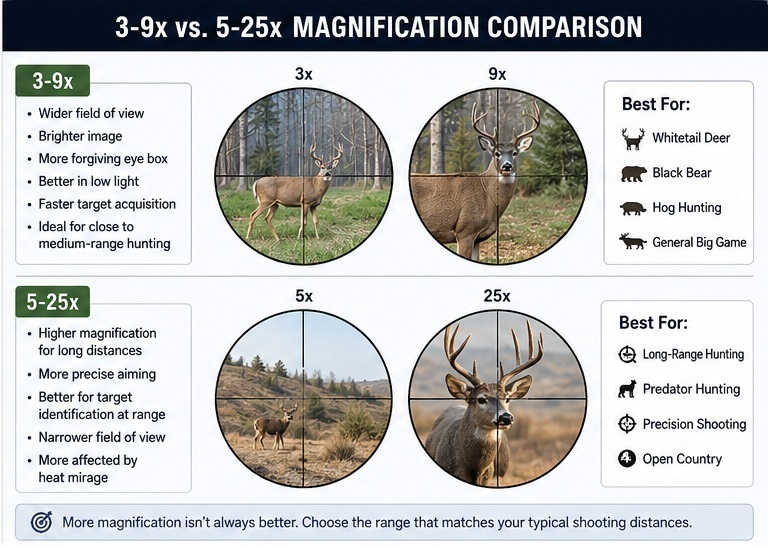
It's an easy mistake to make. You see a scope with 24x or even 36x magnification and naturally assume it must be better than a 3-9x or 3-15x model. After all, if it lets you see farther, it must help you shoot better, right?
In reality, the opposite is often true. One thing we've noticed over the years is that customers almost never call us because they bought too little magnification. They call because they bought too much. They struggle to find deer at close range, carry around a heavier rifle than necessary, or realize they paid for magnification they'll rarely use.
That's why one of the first things we ask customers is what they're hunting and the typical distance they'll be shooting. Choosing the right magnification starts with understanding your hunting style, not simply buying the highest-powered scope available.
We've talked with countless hunters who purchased high-powered tactical scopes for whitetail hunting, only to discover they struggled to find a deer standing 40 yards away because the scope was still set on maximum magnification.
For most deer hunters, a quality 2-10x, 3-9x, or 3-15x scope provides all the magnification they'll ever need—and often performs better in real hunting situations. Examples include the Leupold VX-3HD 3.5-10x40, Zeiss Conquest V4 3-12x44, or Vortex Viper HD 3-15x44. All three offer magnification ranges that are well suited to the vast majority of North American big-game hunting.
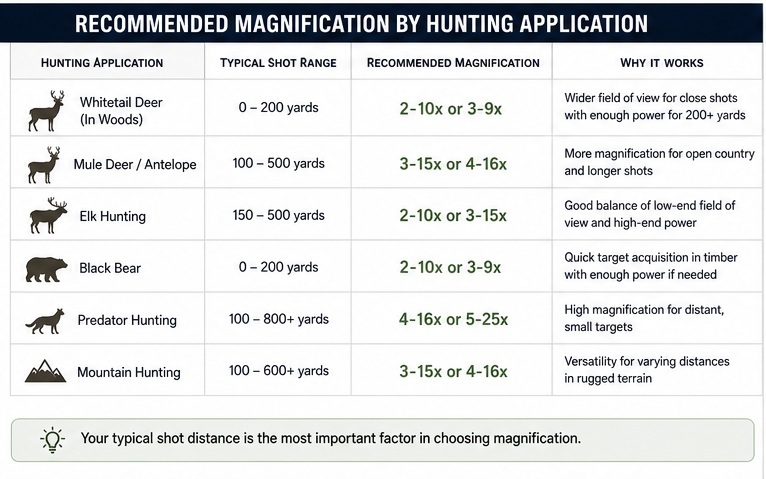
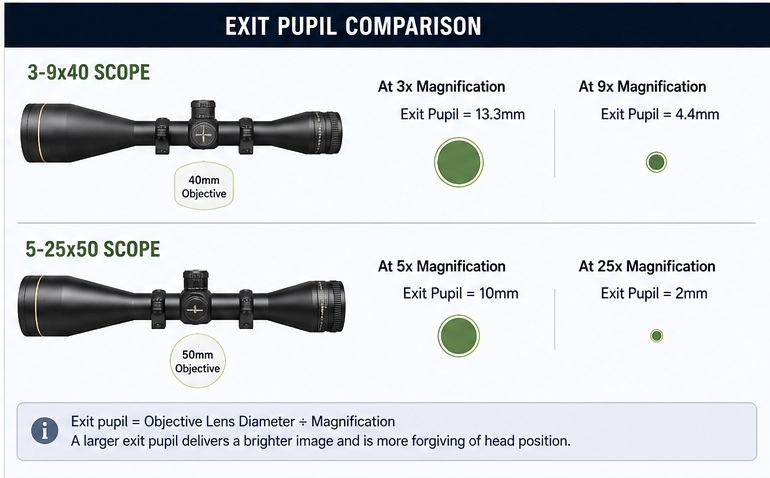
Higher magnification narrows your field of view, reduces exit pupil, makes eye placement less forgiving, and typically adds unnecessary size and weight to your rifle.
Our advice is simple: buy the magnification that fits the way you hunt, not the biggest numbers on the box. More magnification doesn't automatically make you a better hunter.
If you're ready to compare scopes with these magnification ranges, browse our Rifle Scopes collection to find models suited for everything from whitetail hunting to long-range shooting.
Don't Buy a Scope for the "What If" Shot
One question we hear all the time is:
"I might have a 500-yard shot someday. Should I buy a 5-25x scope?"
Our answer is usually, probably not. It's easy to shop for the one shot you might take someday instead of the hundreds of shots you'll actually take over the next several seasons. We always encourage hunters to buy a scope that excels in the situations they encounter most often.
When choosing a hunting scope, it's important to buy for the shots you'll actually take—not the one shot you might encounter once every few seasons.
If 95% of your hunting takes place inside 200 yards, your scope should be optimized for those distances. A lighter, lower-powered scope will typically provide a wider field of view, faster target acquisition, and better low-light performance than a high-magnification tactical scope.
Could you use a 5-25x scope for whitetail hunting? Absolutely. But for most hunters, it simply isn't the best tool for the job.
Our advice is to choose a scope that makes your most common shots easier, not one that's built around the occasional long-range opportunity. If your hunting style changes in the future, you can always choose a different optic that's better suited for those conditions.
Bigger Objective Lenses Aren't Always Better
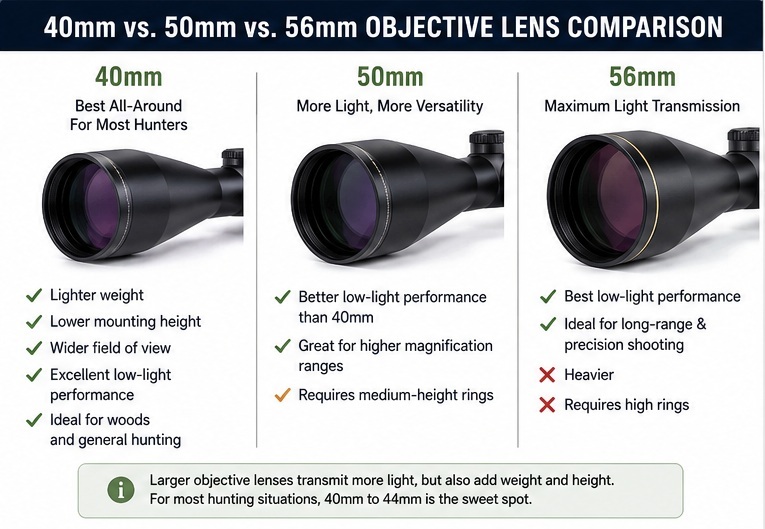
Another common misconception is that a larger objective lens automatically gives you a brighter image.
There's some truth to that—but not as much as many people believe.
Every year we help customers who are convinced they need a 56mm objective because someone told them it "gathers more light."
Our answer usually surprises them. Many hunters are surprised when we recommend a quality 40mm or 44mm objective instead of a 56mm model. In most hunting situations, a lighter scope mounted lower on the rifle is simply more comfortable to carry and quicker to get on target.
To learn more, read our Understanding Exit Pupil and Low-Light Performance article.
Choose Optical Quality Over Extra Features
Today's hunting scopes are available with more features than ever before.
You'll see scopes advertised with:
- Locking turrets
- Zero stops
- Illuminated reticles
- First focal plane designs
- Christmas tree reticles
- Integrated ballistic calculators
- Exposed turrets
Many of these features are genuinely useful—but only if they match the way you hunt.
For the average deer hunter, we'd rather have exceptional optical quality with a simple duplex reticle than an average scope loaded with features that rarely get used.
When legal shooting light is fading and a mature buck finally steps into the clearing, crisp, bright glass will do far more for your success than an extra dial or a complicated reticle.
Our advice is simple: Buy the best glass you can afford first. Features should complement great optics, not make up for mediocre ones.
Keep Your Reticle Simple
One of the biggest changes in hunting optics over the last decade has been the explosion of reticle options. Today you'll find everything from traditional duplex reticles to complex Christmas tree designs with multiple holdover and windage references.
While these advanced reticles certainly have their place, they're not always the best choice for the average hunter. When customers ask us which reticle we recommend most often for big-game hunting, the answer is usually a traditional duplex or a simple BDC reticle. They're easy to learn, quick to use, and inspire confidence when the moment of truth arrives.
If your primary focus is hunting deer, elk, black bear, or other big game, a simple duplex reticle is still hard to beat. It's fast to acquire, uncluttered, and easy to see in low-light conditions, exactly when many hunting opportunities occur.
If you regularly hunt in open country or shoot at extended distances, a BDC (Bullet Drop Compensation) reticle can be an excellent option. It provides additional aiming points for longer shots while remaining straightforward and easy to use.
The key is choosing a reticle you'll actually practice with. Even the best reticle won't help if you're not completely comfortable using it in the field.
Our advice is simple: choose a reticle that matches the way you hunt. A clean, easy-to-read reticle that inspires confidence in the field is far more valuable than an advanced design with features you'll rarely use.
After all, when a buck steps into an opening at first light, you'll appreciate a reticle that helps you acquire the target quickly, not one that forces you to sort through a maze of lines and hash marks.
To help you choose the best reticle, check out our guide, Choosing the Best Rifle Scope Reticle: A Comprehensive Guide.
Invest in Your Optics
One of the most common mistakes we see is hunters spending the majority of their budget on the rifle while treating the scope as an afterthought.
It's not unusual for someone to purchase a $2,000 rifle and mount a $300 scope on top of it. The opposite isn't ideal either—a premium $2,000 scope won't make a budget rifle shoot more accurately.
The best-performing hunting rifles are balanced systems. A quality rifle deserves quality optics, and quality optics deserve properly fitted scope mounts. Even the best hunting scope can't perform as intended if it's mounted incorrectly or with the wrong rings and bases.
Choosing the correct scope ring height is just as important as selecting the scope itself. A properly mounted scope improves comfort, eye alignment, and overall shooting performance.
A quality scope allows you to clearly identify your target, make a precise shot in challenging conditions, and maintain confidence that your zero will remain consistent season after season.
The good news is that a well-made scope can last through multiple rifles and decades of hunting. It's one of the few pieces of hunting equipment you'll likely use for many years, making it an investment that continues to pay off long after the rifle itself has changed.
If you're deciding where to invest your budget, our advice is simple:
Buy the best scope you can comfortably afford. Treat it as an investment and you'll appreciate every time you look through the glass.
Whether you're shopping for your first hunting scope or upgrading to premium optics, explore our selection of Rifle Scopes from trusted manufacturers like Leupold, Vortex, Zeiss, Athlon, Burris, and Sig Sauer.
Understanding Lens Coatings
Lens coatings are one of the biggest factors affecting image quality, especially during the first and last few minutes of legal shooting light. Quality coatings reduce glare, improve light transmission, increase contrast, and produce a sharper image.
One thing we've learned over the years is that not all lens coatings are created equal. A scope with premium glass and high-quality coatings can easily outperform one that simply advertises "fully multicoated" lenses.
Common Lens Coating Terms
- Coated: A single coating on at least one lens surface.
- Fully Coated: A single coating on all air-to-glass lens surfaces.
- Multicoated: Multiple coatings on at least one lens surface.
- Fully Multicoated: Multiple coatings on all air-to-glass lens surfaces for improved light transmission and image quality.
Many premium hunting scopes also feature water-repellent lens coatings. Hydrophobic coatings cause water to bead and roll off the lens, while hydrophilic coatings spread water into a thin film that sheets away. Both help maintain a clearer sight picture in rain, snow, or mist.
Our advice: Don't choose a scope based solely on the words fully multicoated. The quality of the glass, coatings, and overall optical design all work together to determine how a scope performs in the field.
Final Thoughts
After helping hunters choose rifle scopes for years, we've learned that most people don't regret buying a quality scope. They regret buying the wrong one.
The best hunting scope isn't the one with the most magnification, the biggest objective lens, or the longest list of features. It's the one that fits your rifle, your hunting style, and the shots you actually take.
If you're still unsure which scope is right for your next hunt, that's okay.
The right hunting scope won't make you a better hunter overnight, but it can make every opportunity easier to capitalize on. Choose a scope that matches the way you hunt, spend time practicing before opening day, and you'll head into the field with confidence every time you shoulder your rifle.
Ready to Find the Right Hunting Scope?
Now that you know what features matter most, it's time to compare scopes that fit your hunting style and budget. Browse our complete selection of Rifle Scopes to find models for whitetail hunting, western big game, predator hunting, and long-range shooting.
Related Hunting Scope Resources
Continue learning with these helpful guides:
- MOA vs. MRAD: Understanding Minute of Angle and Milliradians
- Scope Parallax and How to Eliminate It
- Choose the Right Scope Mount for your Rifle
- Sighting In Your Rifle Scope: An Ultimate Guide
Whether you're purchasing your first hunting scope or upgrading to premium optics, understanding these fundamentals will help you make a confident, informed decision and enjoy greater success in the field.