
Best Binoculars for Hunting: 7 Hunting Binoculars to Consider
Posted by Jon Jackoviak on Aug 24th 2026
Choosing the best binoculars for hunting isn't simply a matter of buying the binocular with the highest magnification or the most expensive glass. The right hunting binocular depends on where you hunt, how far you typically glass, how much time you spend behind your binoculars, and how much weight you're willing to carry.
A whitetail hunter watching timber and field edges may be better served by an 8x42 binocular with a wide field of view, while a western hunter searching distant hillsides may prefer the additional magnification of a 10x42. Hunters who spend hours glassing may also benefit more from premium optical performance than someone who primarily uses binoculars for quick observation.
For this guide, we've selected seven hunting binoculars from Vortex, ZEISS, Leupold, Leica, and Athlon. They cover different price levels and hunting situations, from value-oriented choices to premium glass.
Rather than simply ranking them from first to seventh, we'll explain what each binocular does well, who we think it is best suited for, and when spending more may—or may not—make sense.
Our Hunting Binocular Recommendations
| Recommendation | Binocular |
|---|---|
| Best Overall Hunting Binoculars | Vortex Razor HD |
| Best Premium Hunting Binoculars | ZEISS Conquest HDX |
| Best Value Hunting Binoculars | Athlon Midas G2 UHD |
| Best for the Dedicated Hunter | Leupold BX-4 Pro Guide HD Gen 2 |
| Best Mid-Priced All-Around Choice | Vortex Viper HD |
| Premium Leica Choice | Leica Trinovid HD |
| Best Premium Athlon | Athlon Cronus G2 UHD |
Best Overall Hunting Binoculars: Vortex Razor HD
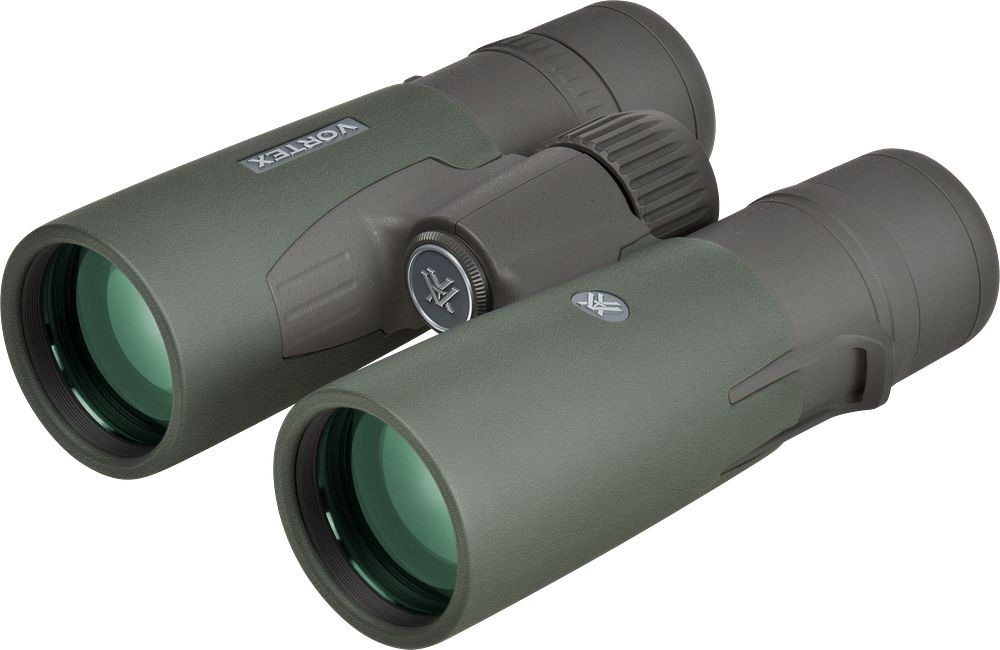
The Vortex Razor HD is our best overall hunting binocular because it provides an excellent balance of optical performance, durability, weight, and versatility without making our recommendation simply about buying the most expensive binocular available.
For hunters, better optical quality becomes especially noticeable when conditions get difficult. Picking an animal out of surrounding vegetation, examining antlers at longer distances, or continuing to glass as daylight fades can expose the limitations of lesser glass.
The Razor HD uses an HD optical system with select glass elements designed to improve resolution, reduce chromatic aberration, and provide better color fidelity. Vortex also uses dielectric prism coatings, phase correction, anti-reflective lens coatings, and ArmorTek exterior lens protection.
What makes the Razor HD our overall choice, however, is its versatility. This is a binocular capable of serving a whitetail hunter in the East while still providing the optical performance needed for more demanding western glassing. You don't have to specialize in one particular type of hunting to take advantage of it.
For woods, whitetail hunting, and mixed terrain, we'd lean toward an 8x42. For western hunting and more open country, a 10x42 gives you additional magnification for examining distant terrain.
Our recommendation: Choose the Razor HD if you want one high-quality hunting binocular that can handle a wide range of hunting conditions and you don't want to feel the need to upgrade again in a few years.
For a closer look at the 10x42 model, read our Vortex Razor HD 10x42 binocular review.
Best Premium Hunting Binoculars: ZEISS Conquest HDX
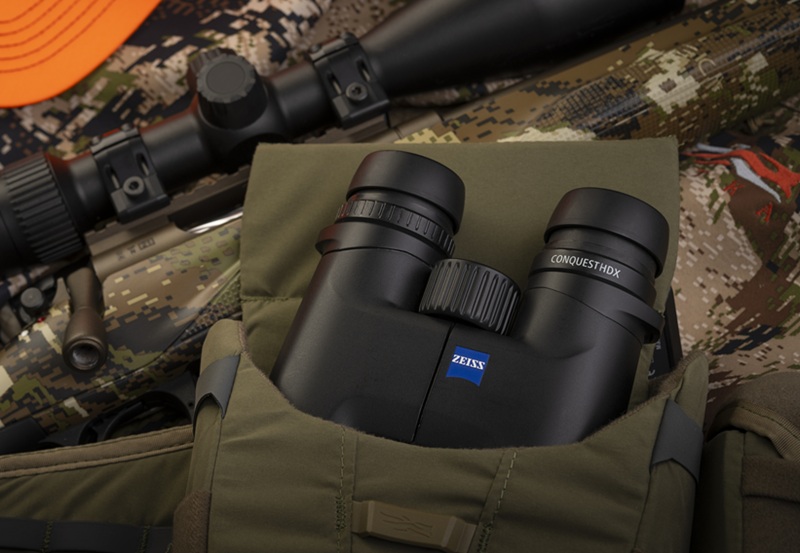
If optical performance takes priority over price, our recommendation moves to the ZEISS Conquest HDX.
ZEISS uses ED glass, FieldFlattener technology, its T* lens coatings, and LotuTec exterior lens coatings in the Conquest HDX. ZEISS specifies approximately 90% light transmission for the system.
The result is a binocular intended to provide strong resolution, natural color reproduction, and good performance in difficult lighting conditions. Those qualities become increasingly valuable when you're glassing around dawn and dusk, looking into shadows, dealing with backlighting, or trying to distinguish fine details at distance.
The 8x42 Conquest HDX provides a 384-foot field of view at 1,000 yards, while the 10x42 provides a 345-foot field of view. Both weigh approximately 25.2 ounces.
We'd favor the 8x42 for whitetail hunting, woods, field edges, and mixed terrain. The 10x42 becomes more attractive for open-country and western hunters who regularly need additional reach.
The Conquest HDX isn't our best overall recommendation simply because not every hunter needs to spend this much to get an excellent hunting binocular. But for the hunter who puts optical performance ahead of price, it's our premium choice.
Our recommendation: Choose the Conquest HDX if you spend substantial time glassing, frequently hunt in challenging light, and are willing to pay more for premium optical performance.
Best Value Hunting Binoculars: Athlon Midas G2 UHD
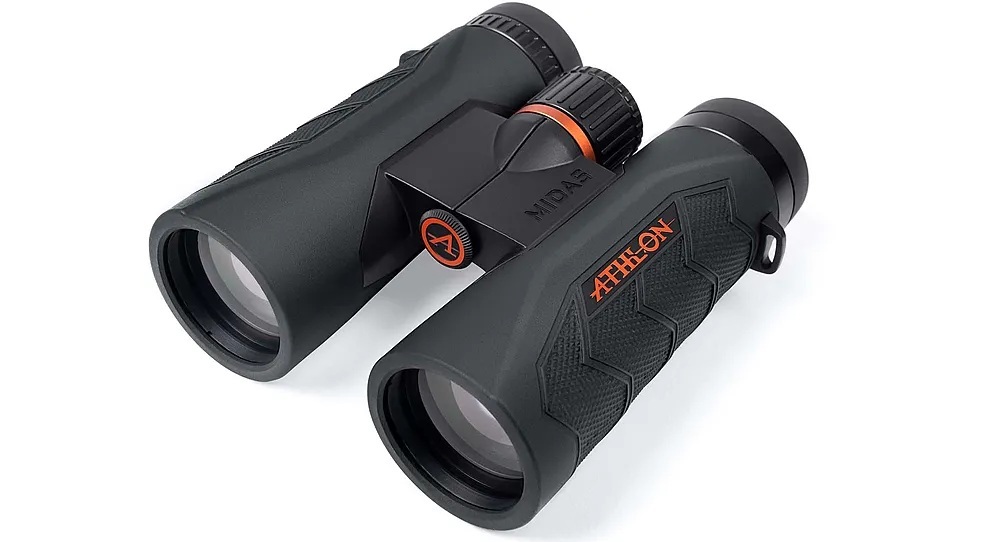
The Athlon Midas G2 UHD is our best value recommendation because it offers a strong combination of optical features, hunting-friendly specifications, and price.
Athlon uses UHD extra-low dispersion glass, ESP dielectric prism coatings, phase-corrected prisms, fully multi-coated optics, and a magnesium chassis. Exterior lenses receive Athlon's XPL protective coating, and the binocular is argon purged for waterproof and fog-resistant performance.
The specifications of the 42mm models are particularly appealing for hunters. The 8x42 weighs approximately 23.3 ounces and provides a 426-foot field of view at 1,000 yards. The 10x42 weighs approximately the same while providing a 341-foot field of view.
That wide field of view makes the 8x42 particularly interesting for whitetail hunting, timber, brush, and other environments where quickly locating an animal can be more important than having maximum magnification.
The 10x42 is the better choice for hunters who regularly glass farther across fields or open terrain.
There are better binoculars in this guide, but that's not the point of the Midas G2 UHD. Its strength is how much usable hunting performance you get without moving into premium pricing.
Our recommendation: Choose the Midas G2 UHD if value is one of your biggest priorities and you want a serious hunting binocular without paying Razor HD or Conquest HDX prices.
Best for the Dedicated Hunter: Leupold BX-4 Pro Guide HD Gen 2
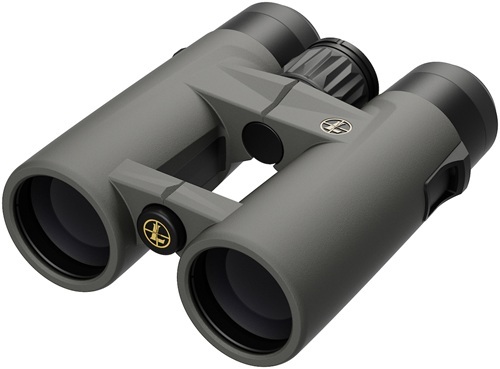
The Leupold BX-4 Pro Guide HD Gen 2 is one of the easiest binoculars on this list to recommend specifically to hunters because Leupold has designed the line heavily around field use.
The current Gen 2 models use Leupold's Elite Optical System and include features such as improved lens coatings, interchangeable Form-Fit eyecups, a locking diopter, waterproof and fogproof construction, and a large focus control that is easier to operate while wearing gloves.
The 8x42 weighs approximately 24.5 ounces and provides a 376-foot field of view at 1,000 yards. The 10x42 weighs approximately 25 ounces and provides a 314-foot field of view.
That illustrates the decision between the two magnifications nicely. Choose the 8x42 when field of view, quick target acquisition, and a steadier handheld image matter more. Choose the 10x42 when you regularly need additional magnification.
For someone who primarily wants binoculars for hunting rather than birding, travel, or general observation, the BX-4 Pro Guide HD deserves serious consideration.
Our recommendation: Choose the BX-4 Pro Guide HD Gen 2 if hunting is the primary reason you're buying binoculars and you want a rugged, hunting-oriented optic without stepping into the highest premium price range.
Best Mid-Priced All-Around Choice: Vortex Viper HD
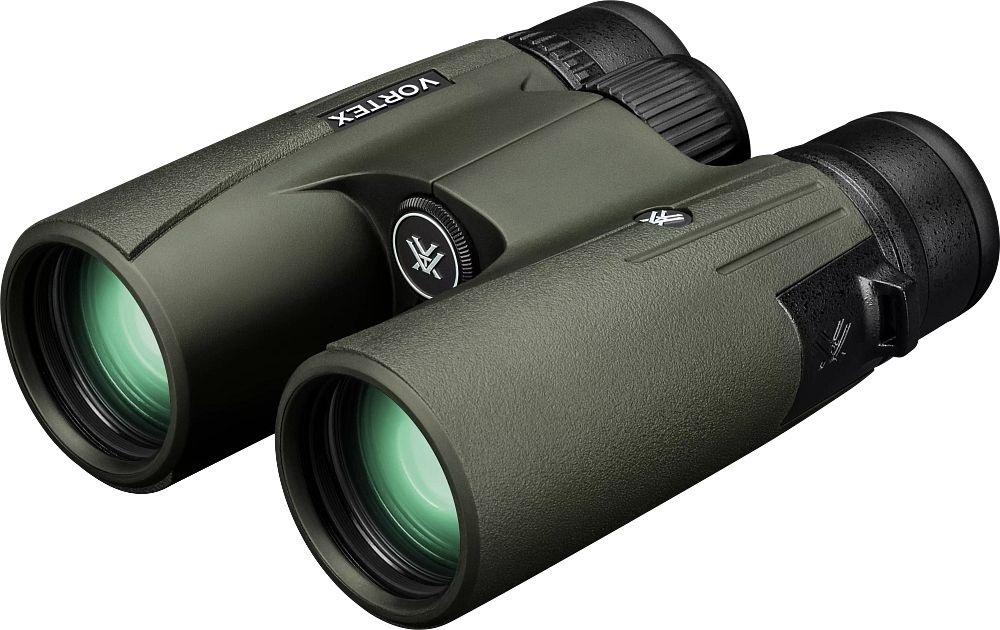
The Vortex Viper HD fills the important middle ground between value-oriented binoculars and premium models such as the Razor HD.
That's a useful position because not every hunter will benefit equally from spending more money on binoculars.
The Viper HD uses an HD optical system, XR Plus anti-reflective coatings, dielectric prism coatings, phase correction, and ArmorTek exterior lens protection. It is also argon purged and sealed for waterproof and fogproof performance.
The 10x42 weighs approximately 24.9 ounces and provides a 341-foot field of view at 1,000 yards, along with 17mm of eye relief.
For a hunter who wants noticeably better glass and construction than an entry-level binocular but isn't ready to make the jump to premium pricing, the Viper HD makes a lot of sense.
We'd lean toward an 8x42 for woods, whitetails, and mixed terrain and toward the 10x42 for more open-country use.
Our recommendation: Choose the Viper HD if you want to move beyond value-level binoculars but aren't convinced your hunting requires the additional investment of the Razor HD or Conquest HDX.
Premium Leica Choice: Leica Trinovid HD
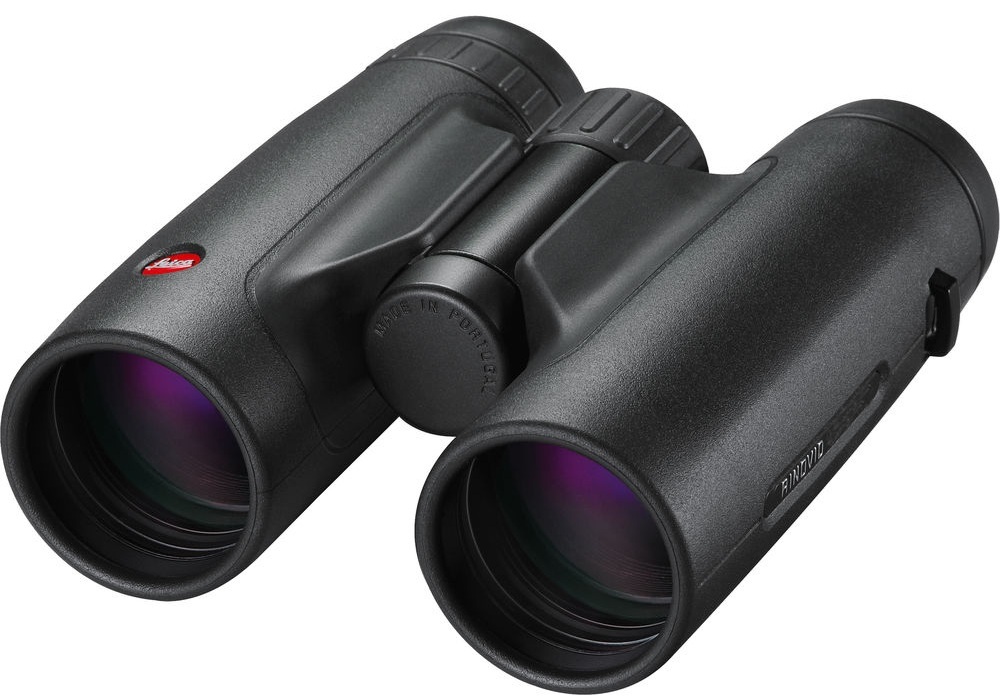
The Leica Trinovid HD is our choice for hunters who want Leica optical quality in a straightforward premium field binocular.
The Trinovid HD is available in both 8x42 and 10x42 configurations, and Leica specifies approximately 90% light transmission.
The 8x42 provides a 372-foot field of view at 1,000 yards, a 5.25mm exit pupil, and 17mm of eye relief. The 10x42 provides a 339-foot field of view, a 4.2mm exit pupil, and 15mm of eye relief.
Both weigh approximately 25.75 ounces.
For woods and mixed terrain, we'd favor the 8x42 because of its wider field of view and easier handheld viewing. For hunters who spend more time examining distant terrain, the 10x42 provides additional magnification without moving to a larger objective.
The Trinovid HD also makes sense for someone who wants one premium binocular for more than hunting. It is equally suitable for wildlife observation, birding, and general outdoor use.
Our recommendation: Choose the Leica Trinovid HD if you value premium Leica optics and want a traditional, versatile binocular rather than a more specialized rangefinding or ballistic binocular.
Best Premium Athlon: Athlon Cronus G2 UHD
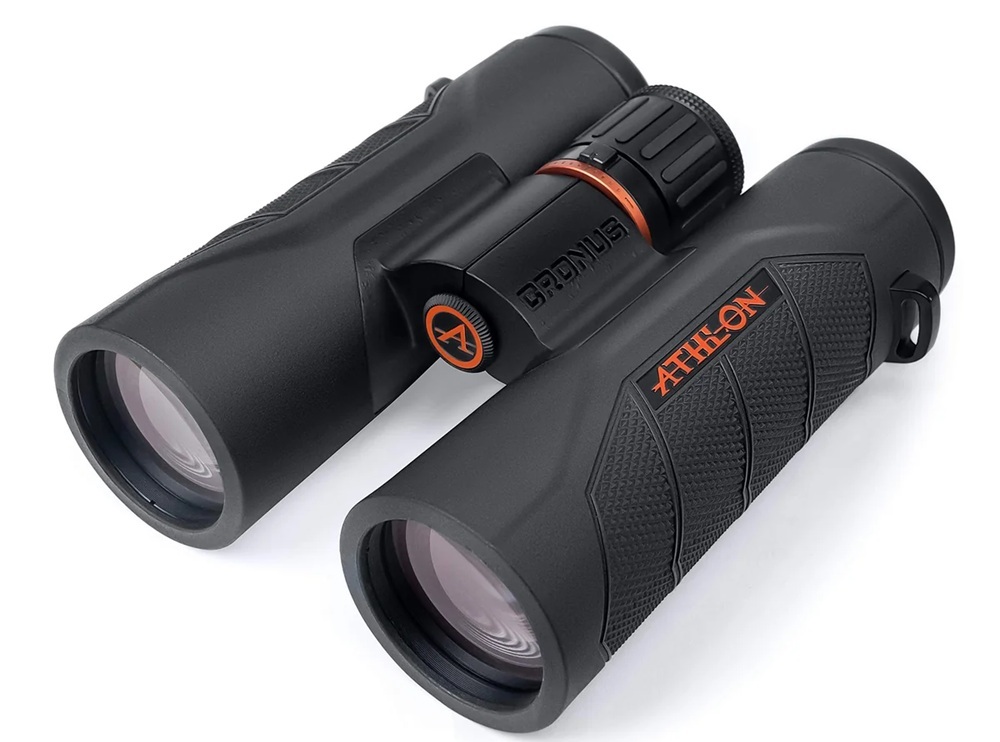
The Athlon Cronus G2 UHD is our recommendation for hunters who like the value Athlon offers but want to move toward the upper end of the company's binocular lineup.
The 10x42 Cronus G2 UHD uses UHD extra-low dispersion glass and Athlon's E2ES field-flattening system, which is designed to maintain image sharpness farther toward the edges of the field of view.
Athlon also uses ESP dielectric prism coatings and a magnesium chassis.
The 10x42 provides a 338-foot field of view at 1,000 yards, approximately 19.3mm of eye relief, and weighs about 27.8 ounces.
The generous eye relief is worth noting for hunters who wear glasses.
Because we're dealing with a 10x42 configuration, the Cronus G2 UHD naturally lends itself to hunting situations where longer-distance observation is important. Western hunting, large agricultural areas, and extended glassing sessions are good examples.
Compared with the Midas G2 UHD, we'd choose the Midas when price and weight are higher priorities. We'd move to the Cronus when optical performance and extended glassing become more important.
Our recommendation: Choose the Cronus G2 UHD if you want Athlon's higher-end optical performance and spend enough time glassing at distance to justify stepping above the Midas G2 UHD.
8x42 vs. 10x42 Binoculars for Hunting
One of the most common questions when choosing hunting binoculars is whether to buy 8x42 or 10x42 binoculars.
Neither is automatically better.
An 8x42 generally gives you a wider field of view and a steadier handheld image. That makes it especially useful for whitetail hunting, bowhunting, timber, woods, and mixed terrain where locating an animal quickly can be more important than maximum magnification.
A 10x42 provides additional magnification and is often better suited to open country. If you're regularly scanning distant hillsides, large fields, cuts, or western terrain, the additional magnification can help you examine distant objects more closely.
You can see the tradeoff in the binoculars we've recommended. The ZEISS Conquest HDX goes from a 384-foot field of view in the 8x42 to 345 feet in the 10x42. The Leupold BX-4 Pro Guide HD Gen 2 goes from 376 feet in the 8x42 to 314 feet in the 10x42.
Choose 8x42 Hunting Binoculars If:
You primarily hunt whitetails, woods, timber, or mixed terrain; you want a wider field of view; you frequently need to locate moving animals; or you prefer an image that's easier to hold steady.
Choose 10x42 Hunting Binoculars If:
You hunt open country, regularly glass longer distances, hunt in the West, or place a higher priority on magnification than field of view.
For many hunters, 42mm objectives provide the best overall balance between optical performance, size, and weight.
What Should You Look for in Hunting Binoculars?
Magnification is important, but it shouldn't be the only consideration when comparing binoculars for hunting.
Optical Quality
Better glass, coatings, and optical design can improve resolution, contrast, color reproduction, and overall image quality.
The difference becomes increasingly noticeable as conditions become more difficult. A hunter looking across a bright field at midday may not notice the same differences as someone trying to identify an animal against a shaded treeline during the final minutes of legal shooting light.
This is also why premium binoculars tend to make more sense for hunters who spend significant amounts of time glassing.
Low-Light Performance
Hunting frequently puts binoculars to work around dawn and dusk.
Objective size plays a role in low-light performance, but bigger isn't automatically better. Glass quality, lens coatings, prism quality, optical design, and light transmission all contribute to the image you actually see.
Moving from a 42mm binocular to a 50mm or 56mm model also means carrying a larger and usually heavier optic. For most hunters, 42mm provides an excellent compromise.
Field of View
Field of view tells you how wide an area you can see through the binocular at a specified distance.
A wider field of view can make it easier to locate animals and follow movement. This is one of the major reasons an 8x42 can sometimes be a better hunting binocular than a 10x42, even though the 10x provides greater magnification.
More magnification isn't automatically more useful.
Weight
Binocular weight is easy to overlook when you're comparing specifications online. It's considerably harder to ignore after carrying binoculars for an entire day.
A few ounces can become important for western and backcountry hunters who are already carrying a rifle, ammunition, water, rangefinder, spotting scope, tripod, and other equipment.
Think about how you'll actually carry your binoculars—not simply how they feel when you pick them up for a few minutes.
Eye Relief and Viewing Comfort
Hunters who wear glasses should pay particular attention to eye relief, but viewing comfort matters to everyone.
Eyecup design, focus-wheel placement, balance, interpupillary adjustment, and general ergonomics become increasingly important the longer you stay behind the binocular.
If you glass for hours at a time, comfort deserves more consideration than it does for someone who uses binoculars only occasionally.
Durability and Weather Resistance
Hunting binoculars aren't used in controlled conditions.
Rain, snow, dust, temperature changes, mud, and accidental impacts are normal parts of field use. Waterproof and fog-resistant construction should therefore be considered basic requirements for a serious hunting binocular.
Exterior lens coatings that help resist scratches, water, dirt, and fingerprints can also be valuable in the field.
Do You Need Expensive Binoculars for Hunting?
No.
But there's an important difference between needing premium binoculars and being able to benefit from premium binoculars.
Consider two very different hunters. A whitetail hunter watching a 150-yard field for an hour in the evening probably doesn't need the same optical capability as a western hunter spending several hours systematically glassing mountainsides miles away.
As glassing distance, time, and difficulty increase, improvements in resolution, contrast, glare control, edge performance, and viewing comfort become increasingly valuable.
That's why our recommendations span several price and performance levels.
The Athlon Midas G2 UHD is our value choice. The Vortex Viper HD and Leupold BX-4 Pro Guide HD Gen 2 occupy the middle ground. The Vortex Razor HD is our best overall recommendation, while the ZEISS Conquest HDX is our premium choice for hunters who place optical performance ahead of price.
The goal shouldn't be to buy the most expensive binocular you can afford. It should be to buy enough binocular for the way you actually hunt.
Which Hunting Binocular Do We Recommend?
If we had to recommend one binocular for the broadest range of hunters, we'd choose the Vortex Razor HD.
It provides the combination of optical performance, durability, size, and versatility that makes sense for hunters who want one high-quality binocular capable of handling different terrain and hunting styles.
If optical performance is the priority and budget is less important, we'd move to the ZEISS Conquest HDX.
For hunters looking for the most performance for their money, we'd consider the Athlon Midas G2 UHD.
The Leupold BX-4 Pro Guide HD Gen 2 deserves special consideration if hunting is your primary use, while the Vortex Viper HD provides an excellent middle ground between value and premium optics.
The Leica Trinovid HD is a strong choice for someone who wants premium Leica optics in a versatile traditional binocular, while the Athlon Cronus G2 UHD gives hunters another higher-end option for extended, longer-distance glassing.
Ultimately, your terrain should influence the decision just as much as your budget.
For woods, whitetails, and mixed terrain, we'd generally favor an 8x42. For open country and western hunting, we'd generally favor a 10x42.
The best hunting binocular isn't necessarily the one with the highest magnification, the longest specification list, or the highest price. It's the binocular that helps you find game efficiently, see the detail you need, and remain comfortable enough that you'll keep glassing when it matters.
How We Selected These Hunting Binoculars
The Optic Zone has specialized in sport optics since 2002. These recommendations were selected from binocular lines we carry based on optical quality, hunting suitability, magnification and objective options, size and weight, durability, features, price, and overall value.
We also considered how each binocular fits into the larger group rather than simply declaring every model "the best." A hunter looking for maximum value has different priorities than someone who spends hours glassing western terrain or someone looking for premium optical performance.
Where we discuss technical specifications, those figures are based on published manufacturer specifications rather than presenting them as results from our own field testing.
Still comparing options? Shop binoculars at The Optic Zone to compare hunting binoculars from Vortex, ZEISS, Leica, Leupold, Athlon, and other leading optics manufacturers.