
Choosing a rifle scope involves more than deciding on magnification, objective lens size, or brand. One of the most important—and often misunderstood—decisions is whether to buy a First Focal Plane (FFP) or Second Focal Plane (SFP) scope.
Spend a few minutes reading online forums or watching scope reviews and you will quickly notice that first focal plane scopes receive a great deal of attention. Because they are commonly used by precision rifle competitors and long-range shooters, many buyers assume they are automatically the better choice.
In reality, that is not always true.
After helping hunters and shooters choose optics for more than two decades, we have found that the best focal plane depends almost entirely on how the rifle will be used. A whitetail hunter sitting in a tree stand has very different needs than someone competing in a precision rifle match or shooting steel targets at extended distances.
For many hunters, an SFP scope remains the better option because the reticle stays easy to see in changing light conditions and at low magnification. Shooters who frequently use reticle holdovers or engage targets at varying distances may benefit more from the flexibility of an FFP design.
This guide explains how both systems work, compares their strengths and limitations, clears up several common misconceptions, and helps you decide which focal plane best matches your hunting or shooting style.
Understanding First and Second Focal Plane Scopes
The terms First Focal Plane and Second Focal Plane refer to the location of the reticle inside the riflescope.
Although this may sound like a minor technical detail, it has a major effect on how the reticle appears and functions as magnification changes.
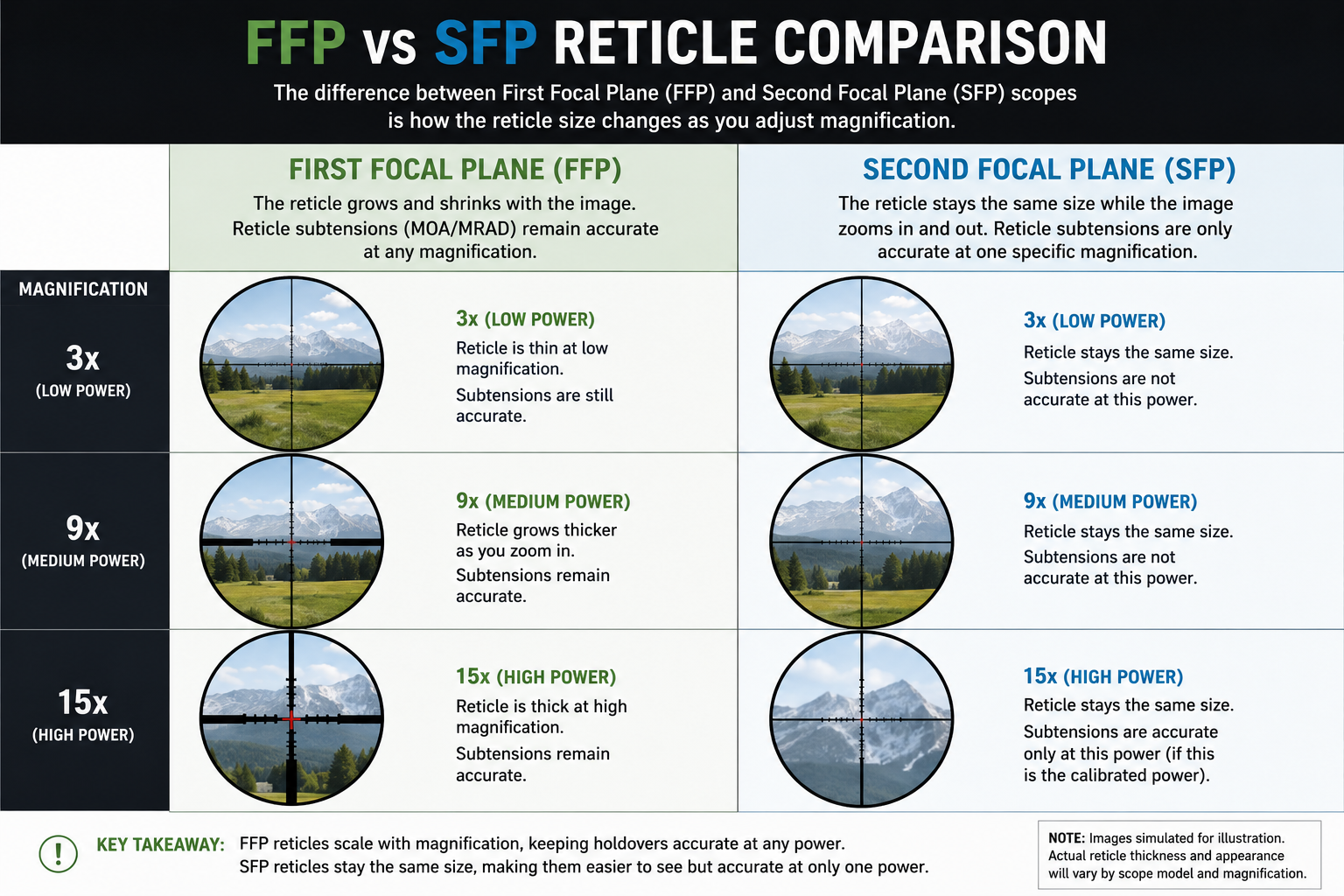
In a First Focal Plane scope, the reticle is positioned in front of the magnification assembly. As you increase or decrease magnification, the reticle changes size along with the target image.
In a Second Focal Plane scope, the reticle is located behind the magnification assembly. The target image changes size when you zoom in or out, but the reticle appears to remain the same size.
This design difference determines whether reticle measurements remain accurate throughout the magnification range or only at one specific power setting.
How a First Focal Plane Scope Works
With an FFP scope, the reticle grows and shrinks as magnification changes. At low power, the reticle appears relatively thin and small. As magnification increases, it becomes larger and more prominent.
The main advantage is that the spacing between the reticle markings remains mathematically correct at every magnification. Whether you are shooting at 5x or 20x, each MOA or MRAD hash mark continues to represent the same measurement on the target.
This allows shooters to accurately hold for bullet drop, estimate range, and compensate for wind without first adjusting the scope to a specific magnification.
For long-range shooters and competitors engaging multiple targets at different distances, this consistency can save time and reduce the need to dial elevation between shots.
How a Second Focal Plane Scope Works
An SFP scope behaves differently. The target image becomes larger as magnification increases, but the reticle stays the same apparent size.
For hunters, this provides an important advantage. The reticle remains bold and easy to acquire, especially at lower magnifications where fast target acquisition and a wider field of view are important.
The tradeoff is that reticle holdover marks are only accurate at one magnification. This is usually the highest magnification setting, although the manufacturer may specify a different calibrated power.
Many hunters rarely notice this limitation because longer shots are often taken near maximum magnification, while closer shots rely on the center crosshair rather than the reticle's holdover marks.
The Biggest Misunderstanding About FFP Scopes
One of the most common questions customers ask is whether an FFP scope is more accurate than an SFP scope.
The answer is no.
The focal plane does not determine the mechanical accuracy of the scope or rifle. A quality SFP scope and an equally well-made FFP scope are capable of the same level of precision.
The difference is simply how the reticle behaves as magnification changes. An FFP scope makes it easier to use holdovers at different magnification settings, while an SFP scope keeps the reticle the same apparent size for easier visibility.
Accuracy still depends on the quality of the optic, consistent ammunition, proper mounting, a correctly zeroed rifle, and good shooting fundamentals.
For more information about how reticle measurements work, read our guide to MOA vs. MRAD.
FFP vs. SFP in Real Hunting Situations
Many comparisons suggest that FFP scopes are the obvious upgrade over SFP models, but those recommendations are often based on competition or tactical shooting rather than normal hunting conditions.
Consider a typical deer hunt. Most shots occur well inside 300 yards, often during the first or last portion of legal shooting light. In these situations, hunters commonly leave their scope on a lower magnification for a wider field of view and faster target acquisition.
Because the reticle in an SFP scope remains the same apparent size, it can be easier to see against a dark animal standing in heavy timber, brush, or poor lighting.
Now consider a western hunter or precision shooter engaging targets from 300 to 800 yards. Instead of dialing elevation for every shot, the shooter may rely on reticle holdovers and wind corrections at several magnification settings.
This is where an FFP scope begins to show its advantages.
Neither system is better in every situation. The right choice depends on your shooting distance, lighting conditions, reticle use, and preferred method of making elevation and wind corrections.
FFP vs. SFP Scope Comparison
| Feature | First Focal Plane | Second Focal Plane |
|---|---|---|
| Reticle changes apparent size | Yes | No |
| Holdovers accurate at every magnification | Yes | No, only at the calibrated power |
| Reticle visibility at low power | May appear thin | Usually easier to see |
| Best suited for | Long-range shooting, competition, tactical use | Hunting and general target shooting |
| Typical price | Usually higher | Usually lower |
Which Scope Is Better for Hunting?
For most hunters, we continue to recommend an SFP scope.
If your shots are generally inside 300 or 400 yards, you will likely appreciate the larger, more visible reticle during low-light conditions and the simpler shooting experience.
Most hunters zero their rifle, understand their practical shooting range, and rarely need to use reticle holdovers at several different magnification settings. An SFP scope handles those situations extremely well.
SFP scopes are especially practical for whitetail hunting, predator hunting, and general big-game hunting where quick target acquisition and a clearly visible aiming point are more important than using complex reticle corrections.
For more help selecting magnification, objective size, and features, read our guide on choosing the right hunting scope.
When an FFP Scope Makes More Sense
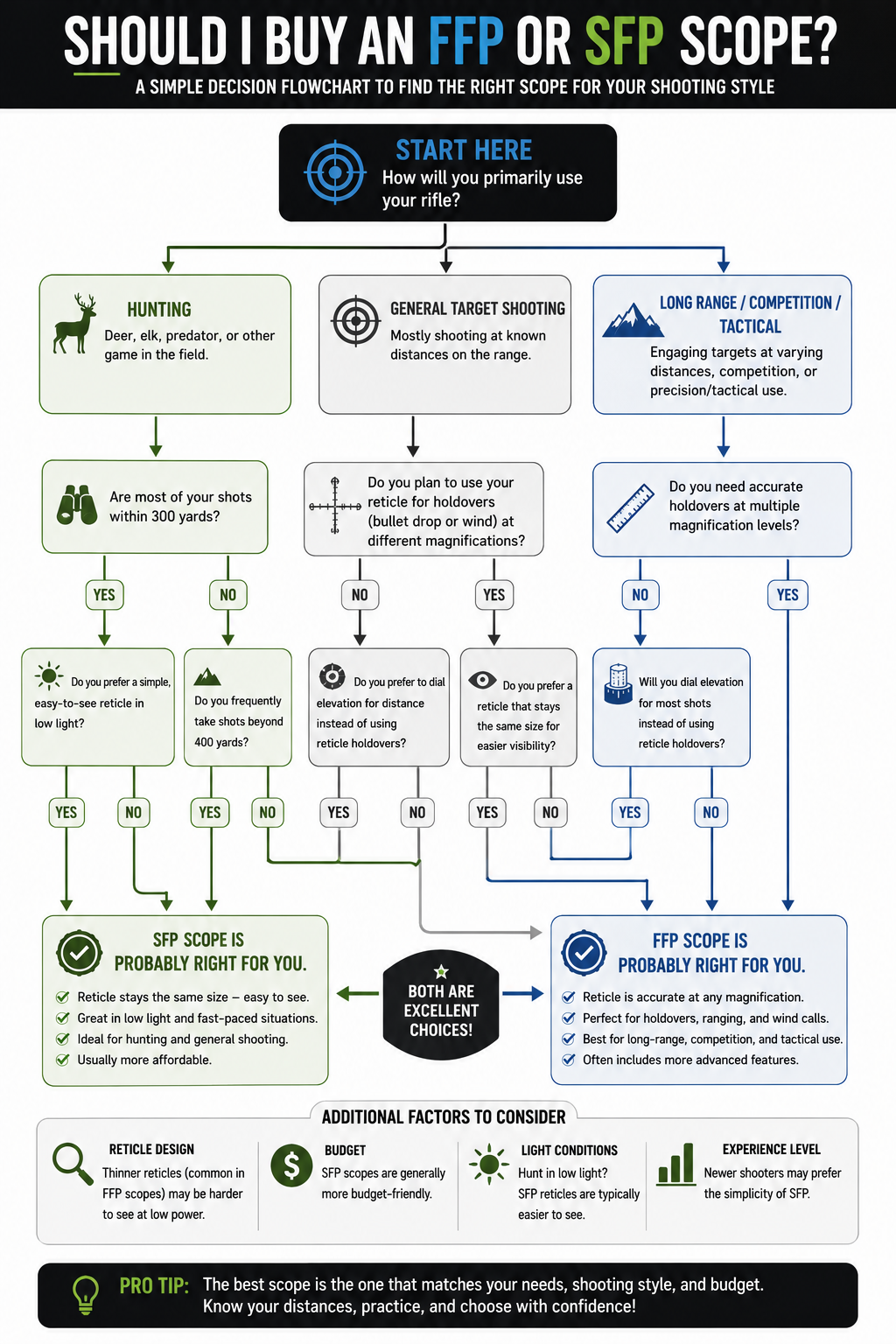
An FFP scope becomes a better choice when you routinely shoot at varying distances and rely on the reticle for corrections rather than dialing the elevation turret for every shot.
This includes precision rifle competitors, long-range target shooters, hunters who regularly shoot at extended distances, and anyone who uses MOA or MRAD reticle marks for elevation and wind holds.
The benefit is not that the scope is more accurate. The benefit is that the reticle remains usable and correctly scaled regardless of the selected magnification.
For these applications, the additional cost of an FFP scope may be justified by the increased flexibility and faster shot corrections.
Should Beginners Buy an FFP Scope?
Not necessarily.
Many first-time buyers believe an FFP scope is the professional option simply because it is common on premium tactical and precision optics. However, many new shooters find an SFP scope easier to learn because the reticle remains constant and easy to see.
A beginner who primarily hunts or shoots targets at known distances may benefit more from a clear SFP reticle, dependable adjustments, and better optical quality than from paying extra for a focal-plane design they may not fully use.
As shooting distances and skills increase, an FFP scope may become a worthwhile upgrade, but it is not required for accurate shooting.
Does Reticle Design Matter?
The focal plane is only one part of choosing the right scope. Reticle design also has a major effect on how easy the optic is to use.
A simple duplex reticle may be ideal for a hunter who wants a clean sight picture, while a detailed Christmas-tree-style reticle may be more useful for a long-range shooter making elevation and wind corrections.
Some FFP reticles become very thin at low magnification. Illumination can help, but it is still important to look at the actual reticle design rather than choosing a scope based on focal plane alone.
Our rifle scope reticle guide explains the differences between common hunting, BDC, MOA, and MRAD reticles.
Our Recommendation
After helping customers select optics for more than two decades, we have found that there is no universally better focal plane. The right choice depends on the intended use of the rifle.
If your primary goal is hunting deer, elk, predators, or other game at practical hunting distances, a quality SFP scope is often the better investment. The constant reticle size is easy to see in changing light, simple to use, and well suited for real hunting conditions.
If you compete, practice long-range precision shooting, or regularly use reticle holdovers instead of dialing adjustments, an FFP scope offers a clear advantage because those holdovers remain accurate throughout the magnification range.
The best rifle scope is not necessarily the one with the longest feature list. It is the one that fits your shooting style, expected distances, preferred reticle, and budget.
Whether you're looking for a lightweight hunting scope, a precision long-range optic, or a versatile all-around riflescope, The Optic Zone offers both First Focal Plane (FFP) and Second Focal Plane (SFP) models to match nearly every shooting style and budget.
Browse our complete selection of rifle scopes or shop by your favorite manufacturer, including Leupold, Vortex, Zeiss, Athlon, Burris, and SIG Sauer. Compare magnification ranges, reticle options, focal plane designs, and features to find the right scope for your next hunt or day at the range.
Frequently Asked Questions
Is an FFP scope more accurate than an SFP scope?
No. Both designs are capable of excellent accuracy. The focal plane only changes how the reticle behaves as magnification changes.
Why do many hunting scopes use SFP reticles?
SFP reticles remain the same apparent size, making them easier to see at low magnification and in changing light conditions. This makes them practical for hunting and fast target acquisition.
Can I hunt with an FFP scope?
Yes. Many hunters use FFP scopes successfully, especially for western hunting and longer-range applications where reticle holdovers are commonly used.
Are FFP scopes worth the additional cost?
They can be if you frequently use reticle holdovers at different magnification settings. For normal hunting distances, an SFP scope may provide better value.
At what magnification is an SFP reticle accurate?
An SFP reticle is usually calibrated at the scope's highest magnification, but this varies by manufacturer and model. Always check the owner's manual before using the reticle for precise holdovers.
Which focal plane is better for beginners?
Many beginners find an SFP scope easier to use because the reticle remains the same apparent size. However, the best choice still depends on the intended shooting application.
Final Thoughts
Choosing between an FFP and SFP scope is not about selecting the newest or most advanced design. It is about choosing the optic that best supports the way you actually shoot.
An SFP scope remains an excellent choice for most hunters and recreational shooters because it offers a clear, visible reticle, straightforward operation, and strong value.
An FFP scope is often the better option for long-range shooters, competitors, and hunters who use reticle holdovers at multiple magnification settings.
Before buying, consider your typical shooting distance, lighting conditions, reticle preference, and whether you normally dial adjustments or use holdovers. Matching the scope to those needs will provide far more value than choosing a focal plane based only on popularity.